
The Charlotte News
Tuesday, May 13, 1958
THREE EDITORIALS

Site Ed. Note: The front page reports from Algiers that angry demonstrators this date had sacked the U.S. Information Agency office and marched on the U.S. Consulate. The USIA office had almost been demolished, with furniture smashed and books thrown out of windows, then torn up in the streets. An American official in the office was uninjured. Two policemen had been on duty near the office but did not interfere. The crowd was demanding that France maintain a firm hold on rebellious Algeria. The crowd then headed up the street to the U.S. Consulate, about a mile away, which had been the scene of a bomb attack several weeks earlier. The demonstrations reflected rising anti-American feeling in Algeria, with many of the French in the country believing that the U.S. wanted to see Algeria independent of France. The demonstrators had broken into the USIA office in mid-afternoon, one group of demonstrators smashing in the front and others smashing the outside nameplate on the office, located on the second floor of an office and apartment building. An American source said that the demonstrators included a number of war veterans who were among the most outspoken right-wingers in Algeria.
In Beirut, Lebanon, rioters had smashed shops, blocked the streets with flaming barricades and chased people from the sidewalks this date in violent protest against Lebanon's pro-Western Government. Demonstrators roamed through Beirut for the second straight day and organized bands were determined to force a general strike and bring business to a halt. They smashed windows and wrecked the interiors of shops which had defied their orders to close. Taxis which ventured into the streets were smashed. A few people who had gone into the downtown streets were scattered by the roving bands. More barricades had been erected in the streets and some had been set on fire to make them more effective as roadblocks. Feverish political maneuvering was underway in an effort to restore order, with the political opposition disclaiming any responsibility for the bloodshed and violence, blaming subversive elements working in the ranks of peaceful demonstrators. (Where and from whom have we heard that bull refuse before, in and since January, 2021?) The reported death toll in a general strike and disturbances which had beset the republic since Saturday had risen to at least 18 when security forces had shot two persons the previous night for failing to halt as ordered. Three bombs had been found on one of the killed persons and a pistol on the other. The Cabinet decided to protest to the U.N. Security Council against foreign interference in Lebanon's internal affairs, with the ministers not naming any country but presumably having in mind the United Arab Republic, recently formed with Syria under the leadership of Egypt's Premier Gamal Abdel Nasser. Radio stations in Cairo and Damascus, the two UAR provincial capitals, had been broadcasting calls for open rebellion in Lebanon, with a Cairo newspaper calling on Lebanese President Camille Chamoun, who was pro-Western, to resign, saying that it would restore calm to the country. The rigid curfew imposed the previous day had produced a long night of calm after the riots. The mobs in Beirut had burned a USIA library, had battled with security forces, closed shops, burned buildings, set up roadblocks, overturned cars and generally stopped transportation. At least five persons had reportedly been killed and 20 wounded in shootings between security forces and rioters. Rioting and shooting had also broken out again the previous day in the north Lebanese port of Tripoli, where another USIA library had been wrecked on Saturday and 11 persons had been killed in fighting between the rioters and police.
In Bogotá, Colombia, Vice-President Nixon, apparently unperturbed by an assassination warning, had made no change this date to his timetable for Caracas, his last stop on his eight-nation Latin American tour—which would prove to be the most violent yet. The Vice-President's aides had received reports from both U.S. and Venezuelan sources that there might be an attempt against his life during his two-day stay in Caracas. One version had said that a university student had been hired to gun him down. The Vice-President described it as a "routine threat" and added, "If we changed our plans every time something like this came up, we wouldn't do anything." He indicated that only a request from the Venezuelan Government could alter his plans. His aide said that normal precautions would be taken, including use of a closed car going to and from public ceremonies. U.S. Embassy officials in Caracas said that maximum-security arrangements already had been made. In Washington, Secret Service head U. E. Baughman said that he had received the assassination report from Frank Barry, a former Secret Service agent, presently a security official with the Nicaraguan Government. Mr. Baughman had said that he did not know where Mr. Barry had obtained his information. Mr. Barry, who was in New York, confirmed that he had given the information but declined to reveal its source. William Key, administrative assistant to the Vice-President, said that there had been earlier tips of violence at other points, including at Lima, Peru, where Mr. Nixon had been stoned and spat upon by Communist-led students. Mr. Nixon told a press conference the previous night that the Russians would step up drastically their Latin American trade offensive in the ensuing few months, that the success of the Soviet bid would be "affected more by what we do than what they do." Earlier, Colombian Foreign Minister Carlos Sanz de Santa Maria told Mr. Nixon that most of South America's economy was dependent on a normal price for coffee and appealed for U.S. help in keeping the price of coffee up so that purchases of American manufacturers could continue.
A Senate Housing subcommittee chaired by Senator John Sparkman of Alabama this date had sought the views of the Federal Reserve Board's chairman, William Martin, on whether the recession might be leveling off. Senator Sparkman said that Mr. Martin would be asked, among other things, "whether there are any signs that the depression has leveled out." He said that he hoped that Mr. Martin would be able to report on any effect which the 1.5 billion dollar emergency housing bill, passed earlier in the year, had on the economy and to suggest what Congress might do further through the annual housing bill presently before the subcommittee, which was holding public hearings prior to drafting a many faceted bill to provide renewed authority for various Government housing programs. Meanwhile, both Senators Sparkman and Homer Capehart of Indiana, the subcommittee's ranking Republican member, backed an Administration request to increase from 3 billion to 7 billion dollars the amount of home loans which could be insured by the Federal Housing Administration between the present time and the end of fiscal-year 1959. The request had been made to the subcommittee by the Housing administrator, Albert Cole, who said that a spurt in housing construction and increased demands for loan insurance would exhaust FHA insuring authority by June 10 unless Congress acted quickly. Mr. Cole had also told the Senators that the Administration wanted to increase from 3 billion to 4 billion dollars per year its request for FHA loan insurance authority in the four years beginning July 1, 1959.
Secretary of Labor James Mitchell was expected to endorse this date a House-passed bill to extend unemployment compensation benefits for idle workers whose rights to compensation would be exhausted prior to the following April 1. The chairman of the Senate Finance Committee, Harry F. Byrd of Virginia, had said in advance of Secretary Mitchell's appearance that he had been assured of strong Administration backing for the measure, indicating that he hoped that they could complete hearings during the current week and could report it to the Senate without major changes from the form in which it had passed the House. The House bill had generally followed the lines of the President's recommendations, authorizing an estimated 600 million dollars in loans to states, which would have to repay the money, but had not included, as the President had proposed, that the extension be made mandatory on the states. Under the bill, insured workers in most states would obtain an additional 13 weeks of payments, but less than that in states which presently had less than 26 weeks of coverage. The duration and amount of payments would vary from state to state.
In Bonn, West Germany, allied military sources stated that a string of Nike anti-aircraft rocket bases would be built in forward areas of West Germany to bolster Western Europe's air defenses.
In Tokyo, Japan had expressed regret over the latest series of U.S. nuclear tests in the Pacific and had asked for their immediate suspension.
In Manila, it was reported that the largest fleet ever assembled for a SEATO exercise had steamed past Corregidor into Manila Bay this date while guns had boomed salutes from ships and shore, the 24 vessels ending a two-week naval training operation.
In Manchester, England, Britain's largest consignment of Salk vaccine from the U.S. had arrived by special plane this date to speed the country's lagging fight against polio.
In London, it was reported that British and Malayan officials had begun work this date on the final draft of a new constitution for Singapore, expecting to complete the work by the middle of the following week.
In Singapore, it was reported that Indonesia had lifted its blockade of once rebellious Sumatra this date and that air service was resuming to Padang, the former central headquarters of rebels fighting the Government.
In Chicago, a pending bill in the Senate to limit jurisdiction of the Supreme Court was described as "unwise and unsound" by the head of the American Bar Association.
In Lincoln, Neb., in the trial of
Charles Starkweather for the murder the prior January 27 of 17-year
old Robert Jensen, one of 11 victims whose deaths were attributed to
Mr. Starkweather and, as to ten of them, also to his 14-year old
girlfriend, Caril Ann Fugate, who had also been charged with the
murder of Mr. Jensen but was awaiting a determination by the State
Supreme Court as to whether she could be tried as an adult or had to
be tried as a juvenile, the prosecutor had read a letter from Mr.
Starkweather which admitted killing Caril's stepfather and stated
that Caril had prevented her mother from killing Charles. The letter
was signed by both Charles and Caril. The stepfather and mother, as
well as a two-year old half-sister of Caril, had been the second,
third and fourth victims for which Mr. Starkweather had acknowledged
responsibility, including his first victim, a young service station
nightshift attendant on December 1, in which Caril was not alleged to have taken
any part. The letter had been taken from Mr. Starkweather after his
capture in Douglas, Wyo., on January 29, and told of how he had gone to
visit Caril, bringing his rifle in the hope of undertaking a hunting
trip with her stepfather, indicating that the stepfather was "happy
and full of jokes", but that his mood had changed to anger when
Caril's mother had ordered Charles to leave and Charles had replied
sarcastically, angering the stepfather, resulting in a fight, ending
with Charles shooting the stepfather. The letter said "at this
mom was so mad that she had [with a picture
In Omaha, it was reported that the vote this date in a primary election was widely forecast to be probably the lightest in many years because of a combination of a favorable crop outlook, a dearth of issues, a heavy field of incumbents and prospects of rainy weather, the predictions being that no more than 180,000 would go to the polls. At stake was the Democratic opponent to incumbent Senator Roman Hruska and the nominees for four Congressional seats, plus control of the Nebraska Legislature, a Republican stronghold for the previous 18 years. Only once since 1940 had a Democrat been elected to Congress, that having been Eugene O'Sullivan of Omaha, who had won a single House term in 1948, and was one of three Democrats seeking the Senate nomination at present. We reiterate that the residents of Lincoln were not probably too disposed to a psychiatric defense in 1958.
In Niagara Falls, N.Y., a leader in the fight to keep the Niagara power project off the Tuscarora Indian reservation, was helping to build the project now. Mad Bear Anderson was hard at work as a laborer for Meritt-Chapman & Scott, the largest contractor on the 625 million dollar project, having put in his first day the previous day at the top of the Niagara gorge about a mile from the reservation. The leader of the young braves of the tribe had led the battle to keep surveyors for the state power authority from working on the land, but had called off the "passive resistance" campaign the previous week when Federal agents threatened contempt of court citations. The state had appropriated 1,343 acres of the Tuscarora reservation, about a fifth of the whole, for part of the reservoir. The Indians had won a Federal court order temporarily keeping the state from taking the land, pending a final decision, with the order, however, permitting surveying in the meantime. Mr. Anderson had said the previous night that he had buried the hatchet with the state power authority, but added quickly, "It's not buried so deep it can't be dug up again."
In Cambridge, Mass., a patrolman had disarmed six fellow officers and held them hostage for an hour in the headquarters guard room the previous night before he had been injured by the accidental discharge of his gun. Police said that they could give no reason why the patrolman, 33, had disarmed the other patrolmen at gunpoint as each had entered the guard room separately. The six officers had jumped him when he put his gun under his arm to munch on a sandwich offered him by a lieutenant, causing his gun to discharge in the struggle and the slug to enter his lung. He was described in poor condition in a hospital. He had placed each gun he had taken from the officers under his belt. One patrolman who had been held hostage said that the man "looked like a buccaneer" before the guns had been taken from him. Perhaps, it was another example of too much television watching at night. Anyway, it takes all kinds.
In Paterson, N.J., a 35-year old man had walked down the main street of the community the previous day with a ten-gallon hat on his head and two six-shooters at his sides. The partner in a restaurant was on his way to deposit $9,000 in weekend receipts and said that he had donned the cowboy outfit because he had been denied renewal of a gun permit. For eight years he had a license to carry guns, but was refused renewal the previous January on the ground that he did not really need a gun. The New Jersey statute made it illegal to carry a concealed weapon, but there was nothing concealed about the man's weapons on this occasion. He said he wanted to show how ridiculous it would be to walk through town in that way. Four lawmen had corralled him in the city's busy downtown area and escorted him to the location of his deposit, then took him to jail. The police chief then asked him to lay down his weapons and discuss his grievance with the prosecutor. In the end, he was not arrested and the police chief described him as a "responsible and solid citizen". But if he had been black in Paterson...
In Sparks, Nev., the owner of the Nuggett casino had moved his establishment across the street to a new million-dollar building just before midnight, and his customers had gone along as police closed off the street while the carts of cash and other items had been moved across. Players were back at their games in the new building within minutes.
In Los Angeles, the daughter of the late comedian Bob Burns, 20, had been 45 minutes late to court and was sentenced to five days in jail for contempt. She was in court on a charge of heroin possession.
In Moab, Ut., it had taken three days for a two-day boat trip which had ended happily the previous night with the last straggler safely in tow. The 300 passengers had been told that it would be a two-day trip when they had begun it Saturday on the 196-mile tour in 90 outboard motor boats, starting from Green River and going south along the river to the Colorado River, then heading upstream to Moab along the latter stream. Most of the boaters made it to Moab by Sunday night, but a heavy afternoon rain storm had swamped six of the boats and another had capsized, though its three occupants had been rescued and only their gear had been lost. Nine other boats had tied up rather than run the risk of swamping and they were strung out along a stretch of the Colorado River, between 40 and 60 miles south of Moab. Rescue boats had started after them with extra gas and spare engine parts the previous morning. All had made it back by late the previous night without further incident. The idea behind the trip had been publicity for a marathon outboard motor boat race which would follow the same route on June 15. The marathon racers hoped to make that trip in a single day.
In Detroit, a lone gunman, apparently taking a lesson from another robber who had twice preceded him, held up a savings and loan association branch office the previous day and got away with $1,105. The manager, 23, said that the robber was not the man who had taken $4,000 on March 3 and $8,500 on April 11, because that individual was now awaiting trial. The manager said that the gunman handed him a note demanding the cash, put it in his pocket and walked out, not saying a word. The manager said that he did not have to say anything as the robberies were beginning "to be like clockwork around here."
On the editorial page, "Charlotte Joins a Purposeful Parade" finds that civic zeal suggesting the tenacity of the pioneer spirit had flowered fully the previous day with the installation of the trustees of the Charlotte Community College System, the ceremonies having marked the end of a decade of striving to provide for Mecklenburg County residents greatly needed opportunities for higher education at home, a prelude, it hopes, to a successful campaign to provide the system with campuses and buildings.
It indicates that there was nothing novel about the idea of community colleges, nor anything speculative about their value, their worth having been well-tested and their potential so great that 22 states were presently feeding financial aid to locally developed junior colleges. Proposals for Federal aid were also under study. In offering aid to its community colleges, the state had joined a purposeful parade of other states.
In a national survey, U.S. News & World Report had found that junior college enrollment had tripled within the previous 25 years and almost doubled in the previous six years. The magazine had stated: "The growing trend is toward public junior colleges, supported jointly by the community and the state. Almost 90 percent of the junior college enrollment today is in publicly-supported schools." The states saw in junior colleges the most practical and economic means of meeting the crisis in higher education produced by the maturation of wartime babies. The communities saw in them potent assets industrially, educationally and culturally.
The magazine had found that many high school graduates were encouraged and enabled to further their education by the proximity of the community college when one existed. An official of the Casper College in Wyoming, had stated: "Fifty to 60 percent of our local high school seniors are now enrolling in Casper College. Thirty percent went on to college before the local school was organized." Another result was the opportunity for adults to enhance their vocational skills and thereby increase their earning power. Industry was provided with better technicians and the presence of a community college was a powerful inducement of industry to locate. A third of the total enrollment in U.S. junior colleges at present was comprised of adults. The magazine had also found that the enthusiasm for junior colleges had spread beyond those institutions, into the four-year colleges. Robert Sproul, president of the University of California, had said: "I would today urge high school graduates to attend junior colleges unless there is a compelling reason for them to go to a four-year college away from home." Marvin Knudsen, president of Pueblo Junior College in Colorado, agreed, saying: "The first benefit that accrues to most individuals is that the student has two more years to mature under the guidance and leadership of his parents and as a member of his church and other groups. He also frequently has more opportunities to exercise his leadership in social situations, athletics, drama, art, music, etc., because, usually, the junior colleges are fairly small and also because he is not dominated by upperclassmen…"
Mecklenburg County residents did not have an adequate junior-college system, but did have a sound and time-tested foundation in Charlotte and Carver Colleges, and as a result of State aid in the form of matching funds, a fully equipped community college system was within the community's reach. It finds that therefore the trustees who had been installed the previous day soon would be asking the support of the community in seizing that opportunity, which it finds too good for the community to miss.
"W A. Kennedy: Man with a Purpose" indicates that the death of Mr. Kennedy on the eve of his installation as a trustee of the Charlotte Community College System had been a blow to the entire community he had loved and had served with dedication.
The development of a great community college in Charlotte had become over the years his fondest hope, dream and personal goal, recognizing earlier than others its great need and the path to take to achieve it.
He had pleaded, wheedled, coaxed and occasionally even shamed the entire county into taking the necessary steps to achieve it, and refused to retreat until the dream was realized. It finds it especially tragic that at the very time of greatest promise, he had died, on the day before he was to take his seat on the board of trustees of the system.
It indicates that the battle for the community college system would have to continue as would the determined spirit of men like Woody Kennedy. "Without it, dreams have no substance and no meaning and progress becomes merely a mirage."
As indicated, Charlotte College would become a four-year college in 1964 and the following year would become part of the Greater University system, as UNC-Charlotte.
Carver College, the community college then serving black students, subsequently, in 1963, became Central Piedmont Community College, serving students of all races.
"The Mobs Have Nothing To Be 'For'" indicates that rocks and spittle had struck Vice-President Nixon in Lima, but that the real target had been the United States. "The tragedy, as Mr. Nixon seemed to note, was that the attack had no real aim other than to serve as an outlet for the formless manias of a mob. The actions of the students not only were cowardly, but otherwise contemptible in that the students apparently were acting at the behest of a Communist conspiracy dedicated as surely to the destruction of their rights as to the freedoms of Americans."
It suggests that while the U.S., with more studied emphasis on good neighbor relations, might become a better friend of Peru, it was at present the best friend the Peruvians had, and the abuse of the Vice-President had only been a part of the burden which the U.S. had to carry as the "shield against Soviet imperialism."
It predicts that there would be other exhibitions of anti-Americanism in South America and elsewhere by people who had found little in their own national past or prospects to be for, that those people felt deeply, but thought little about the motives of the agitators who played upon their passions. "They strike out blindly; for them, the striking out is the important thing."
It finds that Mr. Nixon had exercised wisdom and restraint, correctly assessing the stupidity of the mob and declining to make an official protest. "His attitude in this respect provides a good example for the U.S. government and its fellow Americans."
It suggests that if the Peruvian mob and its counterparts around the world were stupid, they were also, in their aggregate, powerful and capable of great mischief. It finds the incident in Lima to have been another warning that Soviet imperialism had to be fought not only at the government level but also among the masses.
"As if to underline the warning there came news of the anti-American riots in pro-Western Lebanon."
The problem, of course, with Mr. Nixon was that he did not learn the lesson, at least not carrying it forward into his own Presidency, but rather internalizing, to an absurd degree, any form of criticism from young people and the press—not unlike the current occupant of the White House, only in spades. Such people need to understand that they have been elected as public servants, not as kings or dictators, and that their power is only as strong as their willingness to be prudent in the exercise of that power with respect to all in the country, all of whom are their constituents, not just those who voted for them, not just those who like them, and in the process to abide by the Constitution and the laws of the land, no matter who among their most loyal supporters counsel the contrary to achieve particular political ends, which will, even if achieved, last for only a very short time before being reversed, as no one for long will be compelled by a dictator ignoring the Constitution and laws. They have to keep uppermost in mind their proper role, that leadership is exuded best when it is equally applied to all and not just to those who are presumed to have voted for the leader. A large problem with Mr. Nixon is that he could never do that for long, could never, with any credulity, exert true leadership of all people in the country, always having to politicize his speech so as to divide those who supported him from those who did not, leading to the types of complete rejection of him which he found in Latin America, whether actually inspired by Communists or whether simply inspired by an active press, upset the more with considerable fascism ongoing in Latin America at the time, funded in many situations, as we now know, by the United States and its CIA intriguants, seeking regime change whenever it was deemed expedient by persons who had little business communicating those perceptions, skewed as they were by their own personal biases, that a current regime was tainted by Communism, rather than simply a will to effect change for the better for the peasant masses subjected to dictatorships and con artists, often aided and abetted by foreign corporate interests taking advantage of the raw materials in a particular country for their own corporate profits, rubbing the palms meanwhile of those in power in the particular country to enable their robber-baron behavior.
A piece from the Raleigh News &
Observer, titled "On a Sunday Afternoon", indicates
that the Sunday stroll by young lovers seemed pretty much a withered
rose at present, whereas they had once walked out regularly around
this time of year to see the "strange and ennobling magic the
fields and woods had wrought since last Sunday afternoon. They
usually wore their Sunday clothes, but the girl often carried her big
floppity hat in her hand, and the boy twirled his stiff sailor,
happily, excitedly, and nervously. They didn't hold hands until the
town streets bumped their hard heads against the soft grass of a
meadow, but the way they had of walking, of looking, of smiling, must
have prompted the grand old tune, 'Every Little Movement Has a
Meaning All Its Own'
They had a special creek into which they tossed pebbles, a huge rock on which the boy enthroned the girl or a particular spring from which they cupped the flow in the manner of Joshua's warriors. He had picked her a bunch of meadow flowers and she had carried them tenderly, as if they were highly perfumed love songs, at home pressing one or two in her memory book.
There had always been something especially delightful to seek, "the wild rose that was there every season but was always so overwhelming they thought they were the first ever to look upon its radiance."
"They made a picture, an old-fashioned study in leisurely grace and ease, an unhurried print always provocative of lavender and lace, or organdy, of a wisp of blue coat and white trousers and eternally of starch and soap and sachel powder. They didn't always get married and live happily ever afterward, but so to think somehow spoils the recollection of those buried Sunday afternoons. There is no point, certainly at this season, in not remembering that they cut their initials within a heart on a tree."
That, in the end, must have been all that Charles and Caril were doing on their short road trip the prior January, both having a great longing for the lost past and innocence which had been that of their grandparents and earlier, feeling themselves prohibited from enjoying it by the stuffy older generation too busy going about the business of earning a living to be any more concerned about the stuff of young romance. After all, the first murder committed by Charles had been because the service station attendant, who had no authority to do so, would not extend to him credit so that he could buy a stuffed animal for Caril, presumably as her Christmas present. And the rest of it seemed to proceed from there, once committed to the idea that no one would stand in their way of taking their road trip to freedom, regardless of the consequences. Of course, both should have waited and been less impetuous about escaping the confines of Lincoln, Nebraska. C'est la vie… Maybe Charles should have entered a community college and learned a vocation to advance himself beyond the garbage truck.
And to those individuals who disparage "Badlands" as a film for not depicting the "truth" of those murders, you need to understand better the language of film and the idea of an historical novel, which is analogous to "Badlands" and its treatment of the murderous rampage. By adopting pseudonyms for the principal two characters as well as for their victims, while otherwise generally following the path they took, even if considerably prolonging that path beyond the three days on which it actually transpired between the discovery of the first three murders in Caril's home, those of her stepfather, her mother and her baby half-sister, and if taking considerable liberties also with the number of murders, the actual victims and the incidents surrounding them, it told a story much more profound than would merely come from recounting, step-by-step, the actual events as if in a documentary.
The film took the concept of Truman Capote's In Cold Blood, published in 1966, subsequently adapted to the film of the same name in 1967, and carried it one step further, with the historical novel concept translated to film affording a method to get at ultimate truth in a way that merely recounting the "facts" can never do. For no film or book can actually capture all of the facts surrounding a particular case involving murder, as to do so would result in a book which would not only be incredibly boring for its fastidious recounting of detail, but would entail the reading of thousands of pages, ultimately being the equivalent of a court file. Having had to comb through such court files on occasion, we can assure readers that they would not particularly enjoy that task, as much of it entails evidence which is not germane to the matter, but nevertheless has to be examined to search perhaps for a missing grain of information which might help to turn the case one way or the other, especially if the person looking at it does not know what in hell they are looking for or why, in other words not having any legal education behind them. It is the job of the book or film to retell the story in a way which heightens the examination beyond the "facts", which, after all, can be had by watching a documentary.
Thus, films such as "Badlands", taking its cue, perhaps, from the French new wave cinema and Jean-Luc Godard's "Breathless" from 1960, afford a window into the personalities involved in such an episode and its time of occurrence, which is barred and shaded when trying to present "just the facts, ma'am" in a pseudo-documentary. Film in its best use is an art form, not intended to be a documentary, copious or not. And even in the most copious of documentaries, there is editing which inevitably occurs, which eclipses many of the facts, some of which may be quite pertinent to how the average viewer might see the overall picture. Indeed, that usually is the case, with the documentary reflecting the documentarian's own personal view of the matter. That is even more so the case when there is a pseudo-documentary script of one sort or another.
For about 90 minutes of film, "Badlands" captures in itself not just the story of Charles Starkweather and his girlfriend, but explores subtly the motivations of two young, callow people, neither of whom are the brightest tacks in the world, who make decisions whimsically in each moment without forecast or care of consequences, for the need to escape conventional society, choosing in that process quite obviously the wrong road to follow in doing so, and posing, therefore, also an object lesson for viewers, while in no way glorifying violence or in any way tarnishing the memories of those who were the actual victims, rather capturing an incident in the Americana of the late 1950's, quite in distinction to the general run of the mine view of that era as being particularly quiet and innocent—which it was most certainly not, unless you confine your view of it only to the sweet, sentimental movies which came out during it and to the sweet, sentimental music which it produced. Those latter themes are a means of escape from the harshness of any time, and so suggest the opposite of that conveyed by the sentimental sweetness, in contraposition to that from which escape was being effected, with sentimental sweetness, also, we note, being the odor of decaying flesh, mixed with flowers to cloak it. It is obfuscation of the unpleasant at a funereally unpleasant time, but cannot persist later, in any effort to try to get at the actual truth behind any set of circumstances which are tragic and sudden in their occurrence.
People living
in the 1950's and 1960's carried with them constantly, even if
unconsciously, a fatalistic notion that the end of civilization could
take place on any given day or night, nighttime always having been
the toughest in tense times. One could not live in the society without
being made quite aware of that prospect on nearly a daily basis. The
lighter music, the lighter entertainment generally, was designed as
an escape from that morbid reality, especially for the young. It did
not convey at all the reality which most people lived, including the
entertainers who produced the entertainment
Drew Pearson, who was presently reporting while abroad on the progress which Moscow may have made among members of NATO, has his column this date written by his assistant, Jack Anderson, who indicates that now that the public clamor had died down, Congressman Oren Harris of Arkansas had quietly called off the investigation of the second most powerful man in the Government, White House chief of staff Sherman Adams, sometimes called the "assistant president". His name had been on the front pages for a short time during the upset which had followed the firing of Dr. Bernard Schwartz as chief counsel of the House Operations subcommittee investigating scandals in the regulatory agencies, primarily focused at the time on the FCC. As he parted, Dr. Schwartz had accused Mr. Adams of bringing White House pressure on the agencies.
After Congressman Harris had taken charge of the investigation, he brushed aside two letters which Mr. Adams had written to Vice-President Nixon's campaign manager, Murray Chotiner, on behalf of North American Airlines, that firm having hired Mr. Chotiner to straighten out its troubles with the Civil Aeronautics Board. Now, Mr. Harris had closed the file on a more explosive case involving Mr. Adams, ordering Committee investigators to find someone else to investigate.
Mr. Anderson proceeds to provide the facts which Mr. Harris had wanted to suppress, that the Federal Trade Commission records showed that Mr. Adams had intervened to help textile tycoon Bernard Goldfine, who had gotten into trouble with the Government for mislabeling wool products, that after Mr. Adams had become involved, Mr. Goldfine had been excused from further investigation with the admonition not to violate the law again. But in less than nine months, Mr. Goldfine was caught doing the same thing again and on that occasion, the FTC attorney in the case, Charles Canavan, had recommended that criminal proceedings be instituted for "willful and deliberate flouting of the law." But again Mr. Adams had intervened by phoning the FTC chairman, Edward Howrey, and asking him to meet with Mr. Goldfine, whereupon the latter and his son went to Mr. Howrey's office on April 14, 1955 for a confidential conference, at the end of which, Mr. Goldfine had blurted: "Please get Sherman Adams on the line for me." At that point, in front of FTC officials, he made a great show of his friendship with the "assistant president", saying: "I am over at the FTC. I have been treated very well over here. Thanks for arranging the appointment."
Mr. Anderson suggests that the FTC officials could not help but be impressed with "Sherm the firm" Adams. As the President's chief of staff, Mr. Adams wielded more power than any non-elected official in American history. The President seldom approved any paper which had not received the approval of Mr. Adams. Although he was not legally a member of the Cabinet or the National Security Council, he sat in on the meetings of both bodies, arbitrating differences between Cabinet officers and deciding who would be admitted to see the President, as well as running the White House staff.
His friendship with Mr. Goldfine had been something of a mystery, it having been known that Mr. Goldfine contributed to the past political campaigns of Mr. Adams for Governor of New Hampshire and for Congress. Most of the neat, gray suits of Mr. Adams had also been made in Mr. Goldfine's mills. Mr. Anderson finds the most startling description of their relationship to have been given by John Fox, former publisher of the Boston Post, who had charged in Federal District Court the previous month that Mr. Goldfine had embezzled 6.8 million dollars from the Boston Port Development Corp. because Mr. Adams was "in his pocket". He told the Court that he had asked Mr. Goldfine how it was possible for him to keep on embezzling, which he admitted he was doing, and how it was possible for him to dare to do so in the face of the regulations of the Securities & Exchange Commission, and that Mr. Goldfine had responded that "as long as he had Sherman Adams in his pocket, he could do it."
Mr. Anderson concludes that yet Congressman Harris, who was supposed to be investigating both the FTC and the SEC, had instructed his investigators to lay off Mr. Adams.
Mr. Adams would shortly get cornered regarding his wife having received a vicuna coat, an alleged bribe to gain influence, and be forced to resign to maintain the White House in that state where it was "as clean as a hound's tooth".
Joseph Alsop indicates that in a quiet talk recently, Secretary of Defense Neil McElroy had made his best argument that had yet been heard for his controversial bill to reorganize the Defense Department. He said: "I can't see anything ahead but an increasing American defense effort, unless there is a pretty sharp and unexpected change in the world picture. The greatest economy, the greatest efficiency, will not keep costs from going up as the effort increases. So it's only common sense to try to get 100 cents worth of fighting power for every dollar we lay out."
It was the sort of talk which was very different from that of other great reorganizers which the Administration had recruited from big business. Under Secretary McElroy's predecessor, Charles E. Wilson, the unit cost of U.S. defense had risen enormously while spending had dropped. The alleged "economies" had caused a precipitous decline in America's relative strength, while Secretary Wilson had gone on repeating fatuously, "the Russians aren't ten feet high." Mr. Alsop suggests that one finally had to conclude that Mr. Wilson would not have understood the harsh facts of the world power balance if he had been ordered to study them carefully by Harlow Curtis or Alfred Sloan of General Motors, which he had formerly headed. In contrast, a powerful intelligence was part of the remarkable equipment of former Secretary of the Treasury George Humphrey, who was actually Mr. Wilson's master in government. But Secretary Humphrey did not believe anything that was not told to him by an industrialist of a rank equal to his own, limiting his intake of strategic facts regarding the world scene.
Mr. McElroy had come to government with no greater preparation than had Messrs. Humphrey or Wilson, and yet Mr. McElroy had already understood and faced up to the central facts which the others had always refused to face, realizing that the Soviet system had its own terrible kind of efficiency as a brutal machine for increasing the brute power of the state. He realized that it was unsafe not to match increasing Soviet power with increasing American power. He said: "Today we may be about in balance. What I'm terribly concerned about is tomorrow. Really, there are only two alternatives—increased effort on our part, or decreased effort on the Soviets' part. Maybe the Soviet leaders will decide they have to give more to their own people, which will mean less for heavy industry and arms. But I doubt it very much. If they don't make this decision, then we're going to have to choose between accepting a position of dangerous inferiority, or pulling in our belts and intensifying our own effort. It's a contest between two different kinds of social organization, one organized for the welfare of the individual, and the other wholly organized to strengthen the state. Thank God, our system got there first, so we've had a margin. But at least on their chosen ground, the challenge of the other system is now very serious. It's an interesting contest—or rather it would be if we weren't involved in it so completely. Interesting is hardly the word when you're playing for keeps."
Mr. Alsop finds therefore that there was a philosophical side to Mr. McElroy, who had been head of Procter & Gamble before becoming Secretary. Superficially, he was bland enough, although he could be sardonically humorous. He claimed no American miraculous results from his defense reorganization bill, saying flatly that the value of any reorganization "depends on the people you get to fill the slots." But under the surface, Mr. McElroy was also determined and even combative about his bill as well as his job, saying: "Modern weapons cross the lines between the services. Modern weapons leave us almost no warning time at all. If we are going to have an efficient defense with modern weapons, we've got to have a defense based on clear, uncomplicated lines of command and clear, uncomplicated authority for overall planning and programming. Those are the principles. As I told chairman [Carl] Vinson [of the House Armed Services Committee], I will 'take any legislative language that embodies those principles. But I can't compromise on those principles, because I'm sure that any compromise will handicap us badly in the tough contest we have ahead.'"
Mr. Alsop indicates that there was another thing which separated Mr. McElroy from his predecessors, in that they had come to Washington in late 1952 with an almost God-given conviction that they were ideally equipped to "clean up the mess." But Mr. McElroy remarked ruefully that he had undergone "an intensive education in government in these last months, but it's still regrettable that in our government we bring men into top jobs with pretty stiff burdens of responsibility and with no time to learn about the jobs first. I'll be learning for a long time yet."
Mr. Alsop concludes that with reasonable humility thus added to his other qualities, Mr. McElroy, a recruit from the soap business, was a confidence-producing new figure on the scene.
Query what a recruit from Fox Propaganda, with no prior executive experience of any kind, other than a short tenure as head of a non-profit organization which he managed to run into the ground, and with a past checkered by alcohol abuse and partying in public places where ladies frequented without much clothing apparel on their persons, and repeatedly lied in his confirmation hearings, can possibly bring to the Department of Defense in the way of any of those necessary characteristics for proper leadership. That considerable lack of qualifications just showed up in the past week here in June, 2025 in his cheerleading his Leader, as any fathead Goering would do, rather than giving facts to the public and the press about the true nature of the bombing mission to eliminate Iran's nuclear production capability because of having developed about 900 pounds of 60 percent enriched uranium, not reaching the weapons grade 90 percent, with the presence of that 900 pounds, easily transportable by a couple of trucks, now in an undetermined location, undoubtedly, not "buried beneath tons of rock and rubble", following the bombing strike, which had been threatened in advance by His Majesty, who also knows about as much of conducting military operations as would most five-year olds experienced at childhood war games in the backyard, that is, stroking his play-weapon very delicately and thinking himself a big, tough professional soldier, in the present case, one who was too limited in movement by bone spurs to be draft material for the Army during the Vietnam era beginning in 1965, when he was of draft age, 18. His Majesty telegraphed the operation to Iran, giving them plenty of time to move their uranium elsewhere, and in response to that, Iran telegraphed their responsive action, an attack on a U.S. base which took no lives. The whole operation appears only to have been a grand illusion to glorify the Leader, whose poll numbers are sagging badly by the day for his poor performance at home with his tariff war and commandeering of the California National Guard to place Los Angeles under a state of military siege for political theater, combined with his masked goon squads snatching people off the streets merely to meet quotas to satisfy the goons of his MAGA base.
Eric Sevareid of CBS radio indicates that the country had come to one of those periods in history when a psychological gulf was widening between ordinary people and their government in many countries, one in which governments across the East and West boundary saw each other as enemies. "Because their responsibility for security naturally obsesses them, they leave little or nothing to chance, rarely give their supposed enemies the benefit of the doubt. In the meantime, their citizens, through ignorance or perhaps through an instinctive faith that is the ultimate wisdom, less and less regard each other with fear and suspicion."
Thousands of Americans had officially been taught that Russia implacably had plotted America's downfall, while warmly receiving a Russian dance company in New York, as thousands of Russians were officially taught that Americans were cultural barbarians, while giving standing ovations to a young Texan, Van Cliburn, who played the piano.
The two governments hurled official charges and counter-charges at one another every day, but virtually every private American who had gone to Russia experienced polite curiosity at the very least from regular Russian citizens. And virtually every Russian individual who visited the U.S. had the same experience.
Mr. Sevareid says that he had spent part of the weekend with a very old, very respected Hindu ascetic and philosopher, Shankaracharya of Puri. In the thousand-year existence of his religious order, he was the first of its leaders to visit overseas, in spite of his age and infirmities, having spent weeks talking with Americans collectively and individually, with his travels reinforcing his faith that all religions were the same at base, that all human beings were the same. He was aware of what another great war would do to the human story on earth and did not believe that one great power would suddenly attack the other great power, fearing, however, that a spark somewhere kindled by hysteria and passions, might lead the governments, not their leaders, and so believed that there was no choice other than to try to know one another as human beings.
He indicates that there was no guarantee of peace through personal and cultural exchange and intermingling, as the British, the French, and the Germans had lived close together geographically, intermingling in great numbers, absorbing each other's thought and culture considerably, and yet had become embroiled in wars repeatedly. But such intermingling could not harm the prospect of mutual understanding and could only help. "The more our respective people know one another in the flesh, the more inclined they must be to extend the benefit of doubts, the less inclined to be moved to states of passion about each other in times of incident and crisis. Perhaps that is all these exchanges of persons and thought can do. But that is something, and it is something positive at a time when the governments themselves appear stalled at dead and negative center."
He questions how many people really believed that politics and weapons were the way to lasting peace, the only way to explain why the majority of Americans, in an era drenched in talk of weaponry as the key to security, still wanted to see leaders of both the East and West meet once again. He posits that a meeting at present might be a great mistake, with the timing wrong. But the popular feeling, both in the U.S. and abroad, persisted and was growing, perhaps a reflection of the ultimate wisdom. "For consider where even the governments would be, consider the world prospect, if the popular feeling were against such meetings, against personal and cultural intermingling. Then, surely, even the faith in human sanity of such a man as the Shankaracharya would be gravely shaken."
A letter writer suggests that the American people had been justifiably indignant at the reception of Vice-President Nixon in Peru, having been insulted, stoned and spat upon as he had made a friendly visit. Americans had accused the Communists of being wholly responsible for the incident, but he suggests that Americans were far more to blame than the Communists, as during two campaigns and his tenure in office, Mr. Nixon had been the constant target for six years of caustic criticism, ridicule and vile accusations by radio, television, print press and public speakers. "When we set the example for our neighbors, the citizens of nearby countries to follow by subjecting our highest officials, including our President and justices of our Supreme Court, to the most vitriolic verbal abuse that the cruelest of human minds can concoct, sometimes for no other reason than that the person being criticized is affiliated with a different political party to ourselves, how then can we expect those neighbors to respect these same officials?"
The letter writer fails to understand or appreciate that such criticism had quite often been heaped on the nation's leaders, part of the concept of a free press as the "Fourth Estate", an additional check and balance on government excesses, both of power and of formulating policy based on who raised a certain slush fund for the occupant of the office, as well as how that occupant achieved his power and following among his constituents, all combining in the case of Mr. Nixon to have invited close scrutiny and criticism, both for the "Checkers" episode, revealed shortly after his nomination for the vice-presidency in 1952, and in his House career beginning in 1947, when he made his name as a particularly visible member of HUAC in the Alger Hiss case, having run initially both for the House in 1946 and again in 1950 for the Senate by using demagogic tactics involving the Red-smear against each of his opponents, Congressman Jerry Voorhis and Congresswoman Helen Gahagan Douglas, respectively. For the press to have ignored those facts would have been disgraceful to a free press and a complete abrogation of their responsibilty as reporters and editorial commentators.
And, of course, the paranoia which Mr. Nixon felt vis-à-vis the press and Democrats eventually led to his political downfall, with his resignation from the Presidency on August 8, 1974, shortly after the House Judiciary Committee had voted articles of impeachment based on the cover-up of White House operatives' involvement in the break-in in June, 1972 at the Watergate, as well as other covert operations prior to that and otherwise during the 1972 presidential campaign. The overall reason he was forced to resign was an abuse of his power as President, trying to position himself as a king, a violation of the balance of powers.
The current occupant of the White House, not sufficiently having learned his lesson the first time around, appears bound and determined to be ultimately impeached yet again on the very same basis, abuse of power. Given that the current Republican spare majorities in the House and Senate have, collectively, no will to resist that abuse of power, most of them actually encouraging it, that process will likely have to await the midterm elections, which, after all, are now only about 16 months away.
Mr. Nixon, with one of the largest popular vote and electoral vote majorities in the history of the country in 1972, very nearly equaling that of FDR in 1936 and the popular vote margin of President Johnson in 1964, believed himself virtually impervious to impeachment and conviction in the Senate. But by early August, 1974, his own party leaders disabused him of that notion, assuring him that in a trial in the Senate, after it was inevitable that the House would vote the articles of impeachment, he would be able to muster at most about a dozen votes in his favor.
The best laid plans of mice and men oft go agley, even when there is plentiful mouse intercourse afoot.
A letter writer addresses the same topic, wondering whether the Vice-President would return to Washington and, as in the past, "sell Congress and the American people on the necessity of passing out a few more million dollars to our Latin American friends. Or do you think at this late stage of the game he will now bow to the bitter truth that one cannot buy friendship?" The writer suggests that with a little more rough treatment, he would succumb to the old axiom, "Charity begins at home." He says that if Mr. Nixon enjoyed being a target for stone throwers, he would suggest that he return to his own country and visit some Southern cities where the writer was sure he would find a multitude of throwers, "but in his case, instead of being stones, the delivery would be rotten eggs. But excuse me, Sir, after all, like Brutus, our Mr. Veep is an honorable man!"
Of course, the taunts and jeering in South America were not done, as Mr. Nixon would receive even worse treatment soon in Venezuela.
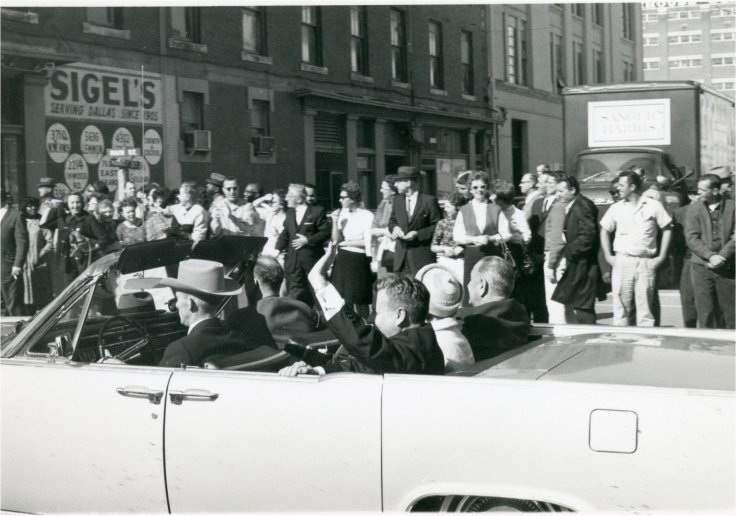
It is noteworthy that less than a month before the assassination of President Kennedy in Dallas in November, 1963, Adlai Stevenson, who was U.S. Ambassador to the U.N., was jeered, pushed and spat upon by some individuals in Dallas on October 24 as he gave a speech on peace. And yet, Mr. Nixon, fully aware that President Kennedy was coming to that hotbed of right-wing politics and potential violence simmering and seething just below the surface, chose to follow a previous commitment to one of his law firm's major clients, the Pepsi-Cola Co., and accompany its chairman by widowed marriage, actress Joan Crawford, to Dallas on November 21, 1963, departing Love Field just an hour before the arrival of President Kennedy that fateful Friday, the following day. He was also quite aware that among the right-wing, there remained afoot an oft-repeated rumor that the 1960 election had been stolen in Chicago and in Texas for President Kennedy by vote manipulation—a crazy theory which usually focuses myopically only on Chicago, neglecting the singular fact that the Illinois electoral votes alone would have made no difference in the election outcome, and also ignores probable vote-rigging in Southern California to obtain that state for Vice-President Nixon, the reason his aides talked him out of contesting the election—, stirring the more, along with the President's recent stand on civil rights, passionate emotions in the South. You can make of that what you will, but it certainly suggests a conscious intent in hindsight by Mr. Nixon to be up to no good vis-à-vis the President and his security, given the backdrop.
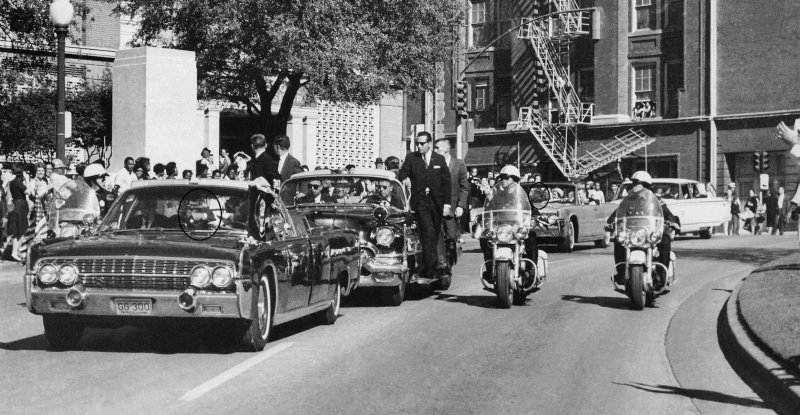
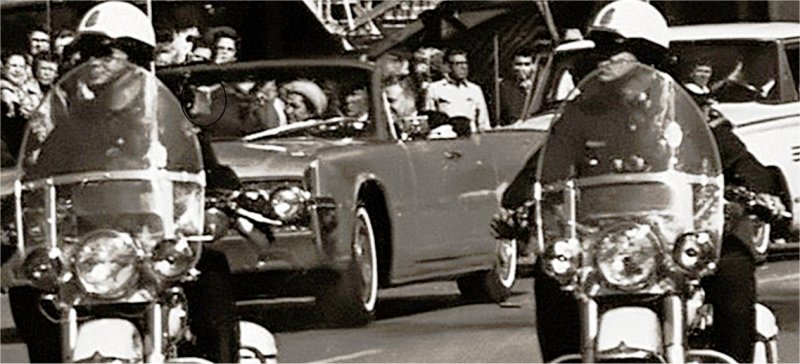
And for those idiots who persist in looking in precisely the wrong direction, at Vice-President Johnson, quite absurdly, he did not duck at all prior to the start of the shooting in Dealey Plaza, as is plain to anyone with eyes to see, looking at a close-up of the Ike Altgens photograph just as the shooting started, and in reviewing the Warren Commission testimony, in which a Secret Service agent assigned to the Vice-President stated that upon hearing the shots, he leaped onto both the Vice-President and Lady Bird Johnson, sitting immediately to the left of the Vice-President, to push them down to the floor of the limousine and shield them. No one, in either the lead limousine of the President, or in the third car back from the President's car in the motorcade, the grey Lincoln of the Vice-President, interceded by the Secret Service car, the so-called "Queen Mary" 1955 Cadillac, ducked prior to the shots.
As we have recounted previously, our sixth grade teacher, a year after the assassination, imparted to the class with a wry smile one day that one of her students had arrived on Monday after the assassination for the half-day of school that day, consumed in most classes by viewing the television presentation preliminary to the President's funeral, indicating, as if no one was aware of the news which had exclusively been the programming since around 2:00 p.m. EST on Friday, and continuing throughout Monday, that, "President Kennedy was assassinated and I know who did it: Vice-President Johnson." The class of sixth-graders of course laughed right along with our sixth grade teacher, as nothing could have been more absurd then or now. Thus, we say to those morons who keep harping on this subject as if there is a shred of credible evidence to support it, that they have about as much sense as that sixth grade girl in 1963.
The very sources of such nonsense, convicted lead Watergate burglar and former CIA agent E. Howard Hunt and his deathbed confession of his foreknowledge of the "big event"
Nixon, Nixon's the One
Framed Edition
Links-Date — Links-Subj.